
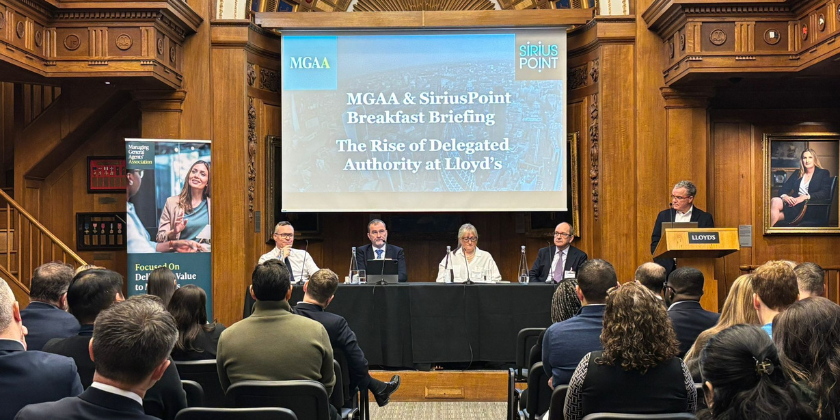
In the historic surroundings of the Lloyd’s Library, Rob Gibbs, President & CEO of SiriusPoint International, Tom Downey, CEO of Pen Underwriting, Ilias Tsakiris, CEO of Hellenic Hull Management, and Laura Hancock, Managing Director of Yutree Underwriting, came together for a discussion on the rise of delegated authority in the Lloyd’s market.
At this week’s event, sponsored by the Managing General Agents’ Association, panelists brought together perspectives from underwriting, broking, and MGA leadership, and explored how delegated authority is reshaping Lloyd’s distribution strategy, competitive positioning, governance expectations, and technological ambition. What followed was an honest and deeply insightful debate about where the market is heading and what must change to get there.
An undeniable theme throughout the discussion was industry collaboration for the benefit of customers as Rob opened the discussion by saying: “Lloyd’s is unprecedented in the world market because of the strength and depth of talent. I see underwriters coming together to create niche products and innovating for the benefit of customers in an ever-evolving world.”
A new MGA landscape: Capability, data and innovation
The discussion highlighted how delegated authority has evolved from a tactical route to market into a central pillar of Lloyd’s future distribution strategy. What emerged most strongly is that MGAs have become sophisticated, data‑driven underwriting businesses whose expertise and agility now shape Lloyd’s competitive edge.
Several panelists described a fundamental shift in status and purpose. As Laura put it, “Delegated authority is not just a bolt‑on distribution channel anymore; it’s a core operating model, and MGAs look like insurers now.” This sentiment reflected the broader view that delegation today enables genuine underwriting innovation, closer customer proximity, and rapid development of niche and emerging product solutions, which was supported by Ilias who described the increasing role of technology in the marine sector: “The more AI we put in our systems, the quicker responses we have, with a better understanding of the risks we are writing.”
Rob reinforced this by linking delegated authority back to Lloyd’s origins: “If you think about Lloyd’s at the very start, it was about innovation driven by customer need. That hasn’t changed. The question now is how Lloyd’s supports MGAs to deliver new products that meet those needs.” In his view, delegated authority is the contemporary engine of the same customer led innovation that has long been part of the Lloyd’s market.
Competition between Lloyd’s and the company market also surfaced. Tom offered a clear challenge: “Company markets are creeping up on what historically was the Lloyd’s space. Why? Because capital is free flowing and international reach is levelling. Lloyd’s needs to ask: what will we do differently to maintain market advantage?” Yet this was positioned more as a catalyst for change than a challenge with Laura noting, “Competition shouldn’t be a bad thing. It drives innovation in the MGA space, and the quality of the MGA becomes what matters most.”
Technology and data emerged as the industry’s biggest friction point. Many MGAs have modernised their workflows and adopted automation, but some still face outdated or inconsistent data demands from carriers, as Laura said: “We can create great tech solutions, but if we still have to download data into a spreadsheet to give to an insurer, you’ve defeated the object.”
Rob, speaking as a capital provider, underlined the need for a unified approach: “We don’t want a SiriusPoint standard, a standard from another carrier, and then a broker standard. We should spend our time talking about risk, not anomalies in data.” The theme was clear: the market must modernise together, not in isolated pockets.
True partnerships & trust
Underlying the operational agenda reaffirmed that relationships remain central. Tom summed it up simply: “It’s the people who do the trading. It’s the people who understand the risk. If the chemistry isn’t right, the partnership won’t work.”
When asked what distinguishes a true long‑term partner, Rob said the ultimate test is shared accountability: “The greatest test of alignment is whether the parties are prepared to put profit at risk together.”
Governance and Consumer Duty were discussed with similar pragmatism. Oversight was welcomed when proportionate and truly customer focused. Laura described how her business embeds Consumer Duty daily: “The fabric of Consumer Duty is used as a force for good. It puts the customer at the centre of everything. Our business is better as a result.” Laura described how her business embeds Consumer Duty daily:
From an international perspective, Ilias emphasised the value of Lloyd’s structure: “Lloyd’s is a brand in its own right. It differentiates because it has clear structures, clear oversight and clear controls. Regulators feel more relaxed when Lloyd’s capacity is involved.”
The panel also explored the increasingly diverse identity of MGAs, from super‑MGAs offering full actuarial and regulatory infrastructure to highly specialised niche players. Ilias noted that expectations have risen: “It’s more expensive to run an MGA today, but it’s necessary. Specialised underwriting, controls, and technology are essential, especially in a sanctions‑heavy world.”
Despite this diversity, the panel agreed Lloyd’s has a role across the spectrum so long as expectations remain stable and transparent.
Talent, purpose and the future of the market
The session ended with a powerful reflection on talent. Rob argued that the industry undersells itself: “We need to celebrate what we do. Delegated partnerships, when truly effective, drive innovation, greater customer understanding and stronger risk management; we don’t talk about it enough,” with Tom echoing his views and asking: “How do we create the best opportunities for the brightest minds?”
Laura stressed the importance of widening access through apprenticeships and school outreach, helping young people see insurance as a professional, purposeful career. Ilias reframed insurance’s societal value, saying, “The energy transition can’t happen without insurance. Climate resilience can’t happen without insurance. The impact young people want to have in the world is possible through this industry.”
Ultimately, the panel presented a vision of a market that is becoming more collaborative, technologically ambitious, customer‑oriented, and reliant on delegated authority as a driver of innovation and reach. Tom captured this as he closed the discussion: “Innovation and customer focus built this market. That’s where its future lies.”